
Lung-on-a-Chip Shows Asthma Attacks Remodel Airways Through Mechanical Force Alone
A multi-institution team used an asthma-on-a-chip platform to show that compression during attacks drives fibrosis and blood-vessel overgrowth independent of inflammation, opening a path to therapies that target permanent airway narrowing.
Today’s Progress
Researchers led by Binghamton University and the University of Pennsylvania have shown that the physical squeeze of an asthma attack can permanently reshape airway tissue even when inflammation is set aside. The work, published in Nature Biomedical Engineering, used a bioengineered “asthma-on-a-chip” to isolate mechanical compression from other disease signals.
About 25 million people in the United States live with asthma. Attacks triggered by allergens, pollution, or weather cause coughing, wheezing, and shortness of breath. Clinicians have long linked long-term airway thickening mainly to chronic inflammation. The new study demonstrates a separate pathway: repeated mechanical stress drives overproduction of extracellular-matrix proteins (fibrosis) and abnormal blood-vessel growth (angiogenesis). Over time those changes stiffen and narrow airways.
Lead author Jungwook “Jay” Paek, assistant professor of electrical and computer engineering at Binghamton’s Thomas J. Watson College of Engineering and Applied Science, began the project as a postdoctoral researcher with bioengineering professor Dan Huh at Penn. Collaborators included teams at the University of Toledo and the Pacific Northwest National Laboratory. Binghamton doctoral student Anika Alim helped build and run the microfluidic device.
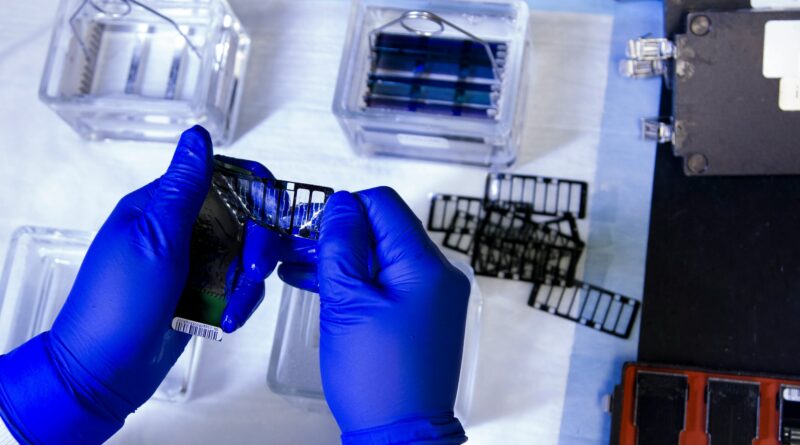
The chip uses microfabrication methods adapted from semiconductor manufacturing. Patient-derived airway epithelial cells and fibroblasts sit in a hydrogel fitted with soft pneumatic actuators. When the actuators contract, they compress the tissue the way airways constrict in an attack. Healthy tissue exposed to the same force barely remodeled. Asthmatic tissue stiffened and showed fibrotic and angiogenic changes. “This is the first time that anyone has demonstrated the effect of a mechanical process on tissue remodeling — including both fibrosis and angiogenesis — in asthma patients,” Paek said, according to Binghamton University News.
The team also tested whether medication delivered on the chip could modulate cellular activity under compression, generating early observations that may guide future remodeling-focused treatments.
Why This Matters
Severe persistent asthma often becomes less responsive to standard anti-inflammatory drugs once airways have thickened and stiffened. If mechanical force itself is a driver, preventing or interrupting that force—or blocking the cellular programs it triggers—could slow irreversible narrowing. The finding does not yet prove a new medicine works in people. It does give researchers a controllable human-tissue model in which they can watch remodeling unfold and test interventions without relying only on animal studies or end-stage patient samples.
Evidence and Context
Strengths include publication in a leading peer-reviewed journal, multi-institution collaboration, and a design that separates compression from inflammation. The platform recreates clinically relevant mechanical stress with living human cells. Limits are clear: results come from engineered tissue chips, not longitudinal patient cohorts. The medication-delivery tests remain exploratory. How well chip findings translate to whole-lung physiology and diverse patient genotypes is still unknown. No clinical trial of a remodeling-targeted therapy based on this work has been reported.
What Made This Possible
Organ-on-a-chip methods matured through years of soft-robotics and microfabrication research. Paek’s prior work in Huh’s Penn lab supplied the asthma-specific platform. Cross-disciplinary teams—electrical and biomedical engineering, physiology, and national-lab analytics—made it possible to apply controlled force and measure matrix and vessel responses.
Progress Toward Global Goals
By clarifying a mechanism that worsens a common chronic respiratory disease, the research supports SDG 3 (Good Health and Well-Being), target 3.4 on reducing premature mortality from non-communicable diseases, to the extent that better mechanistic models can improve future care. No SDG is undermined.
Building on This Success
The following possibilities were generated with the assistance of AI to explore how this progress might be improved, expanded, or adapted. They are ideas for further investigation, not established findings or recommendations from the people featured in the original reporting.
If labs extend the chip to multi-donor panels and couple it with single-cell readouts, they could map which cell states respond most to compression and rank candidate inhibitors before animal or human studies. Hospital research networks might then pilot short-term imaging or biomarker protocols that track matrix remodeling after severe attacks, testing whether early mechanical-pathway blockade correlates with slower loss of airway caliber. Engineering groups could also adapt the same actuators to model other force-driven lung conditions, checking whether shared pathways appear.
How could asthma-on-a-chip isolation of mechanical stress reshape the search for therapies that stop permanent airway narrowing?
Three complementary lenses stand out. First, target discovery: academic and industry labs could use compression-only chips as a primary screen for molecules that blunt fibrosis or angiogenesis without broad immunosuppression; the measurable test is reduced matrix protein deposition and vessel density after standardized compression cycles compared with untreated chips. Obstacle: chip throughput and cost. Second, attack-intensity management: clinicians and device makers might explore whether faster relief of bronchoconstriction—beyond symptom control—limits cumulative mechanical dose; a measurable test would be serial airway-wall thickness or stiffness imaging in patients stratified by time-to-relief after severe attacks. Obstacle: confounding by inflammation and steroid use. Third, personalized modeling: centers with biobank access could seed chips with a patient’s own cells to predict remodeling risk and drug response; success would be concordance between chip remodeling scores and that patient’s clinical trajectory over 12–24 months. Obstacle: regulatory and manufacturing standards for patient-specific chips.
Three Promising Next Steps
- Expand the chip panel across more donors and asthma endotypes, with pre-registered endpoints for fibrosis and angiogenesis after defined compression protocols.
- Run systematic on-chip screens of pathway inhibitors already approved for other fibrotic diseases, measuring matrix and vessel outcomes under mechanical load.
- Pair chip biomarkers with non-invasive imaging in observational cohorts after severe exacerbations to test whether early remodeling signals predict long-term airway caliber loss.
What Readers Can Watch
- Follow-on papers from Paek, Huh, and University of Toledo collaborators that move from mechanism to candidate interventions.
- Clinical studies that measure airway remodeling (imaging or histology) in relation to attack frequency and time-to-bronchodilation.
- Regulatory or funding calls that specifically support organ-on-a-chip models for non-inflammatory drivers of chronic lung disease.